How to measure SAG (and why almost everyone gets it wrong)

For years I thought my bike was just like that. A bit harsh over rough patches, a bit soft under braking, nothing dramatic: that's just how it is, I used to think, and you get used to it.
Then a guy at a rest stop on the Passo Rolle asked me how much SAG I was running. I said I didn't know. He pulled a tape measure out of his pocket, had me sit on the bike, and in three minutes told me the rear was sitting thirty-five millimetres lower than it should.
It wasn't the bike. I had simply never measured it.
The short version: what SAG actually is
When you set the bike down on its own, the suspension compresses under its weight. When you get on, it compresses further. Those millimetres of sag are, unsurprisingly, called SAG.
It sounds trivial, but it's the single most important number in the whole setup, because the suspension has to be able to move in two directions. It has to dive when you hit a bump, sure. But it also has to be able to extend when the road drops away, otherwise the wheel is left hanging and the tyre loses contact exactly when you need it most.
Sit too high and you have no margin underneath. Sit too low and you have no margin above. SAG is the compromise, and it has to be measured, not guessed.
There are two SAG measurements, and they answer two different questions:
- Static SAG is how much the bike settles on its own. It tells you whether the spring is right for that motorcycle.
- Dynamic SAG is how much it settles with you on board, dressed as you ride. It tells you whether the spring is right for you. This is the one that matters.
What you need
Not much, and nothing specialised.
A rigid tape measure — the carpenter's kind that stays straight on its own. A soft tailor's tape bends and will throw you off by two or three millimetres, which on a thirty-millimetre measurement is ten percent.
A zip tie. Costs nothing, and later becomes the most useful diagnostic tool you own.
A friend. Two is better. There's no way around this: solo measurements with the rider aboard don't work, and I'll get to why in a moment.
A centre stand or a paddock stand, for the first measurement with the wheel off the ground.
And masking tape plus a pen — the part everyone skips, and the part that decides whether the work you're about to do is worth anything.
Before you start, a couple of serious points
Flat surface, cold bike, bike properly secured. Never touch the brake system or anything structural, and if an adjuster won't turn, stop: forcing it means ruining it, and then the problem costs ten times as much. When you're done, recheck every fastener before riding off.
The three measurements
It all comes down to measuring the same distance three times, in three conditions.
! [The three measurements L1, L2, L3](/immagini/tre-misure-L1-L2-L3.jpg)
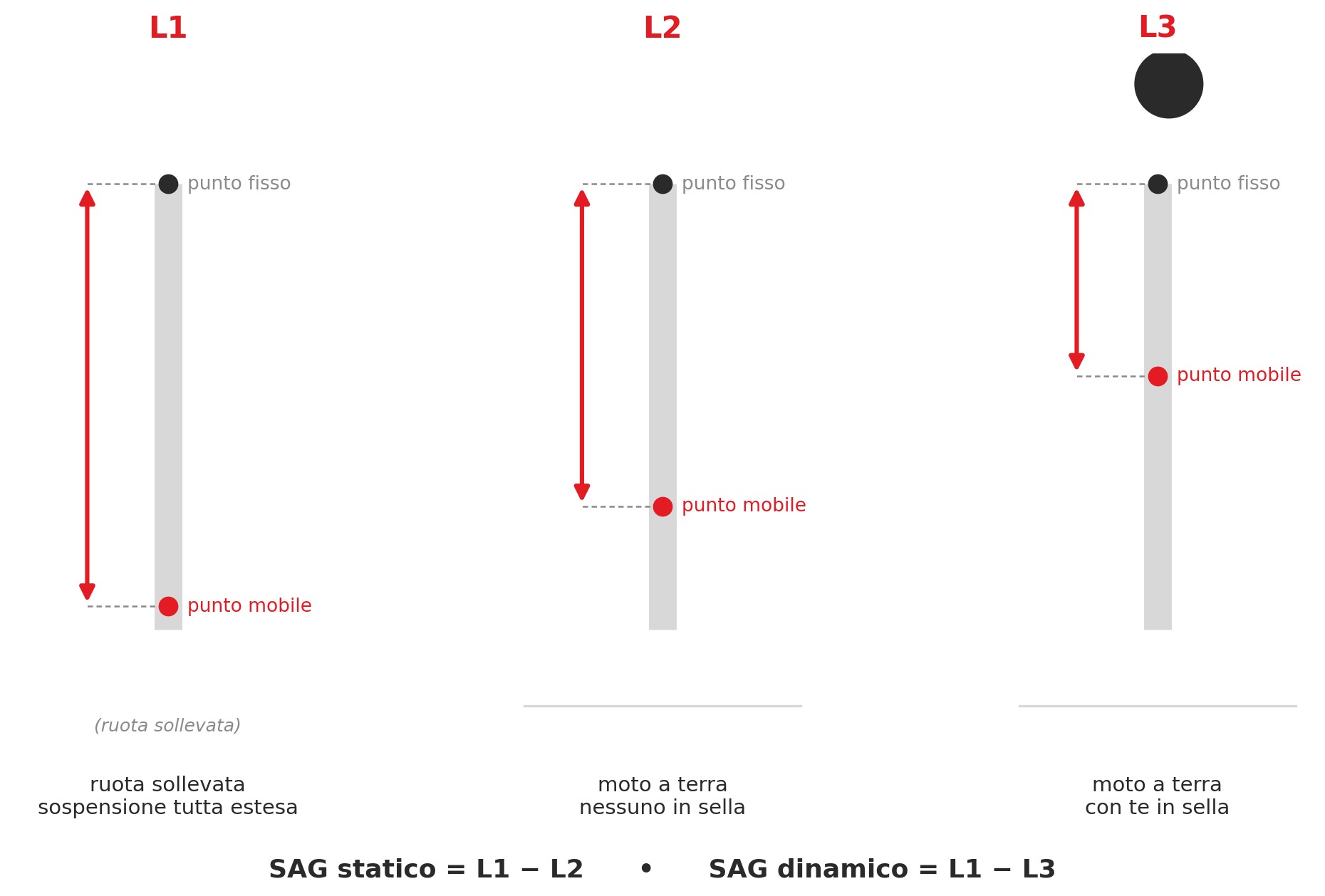
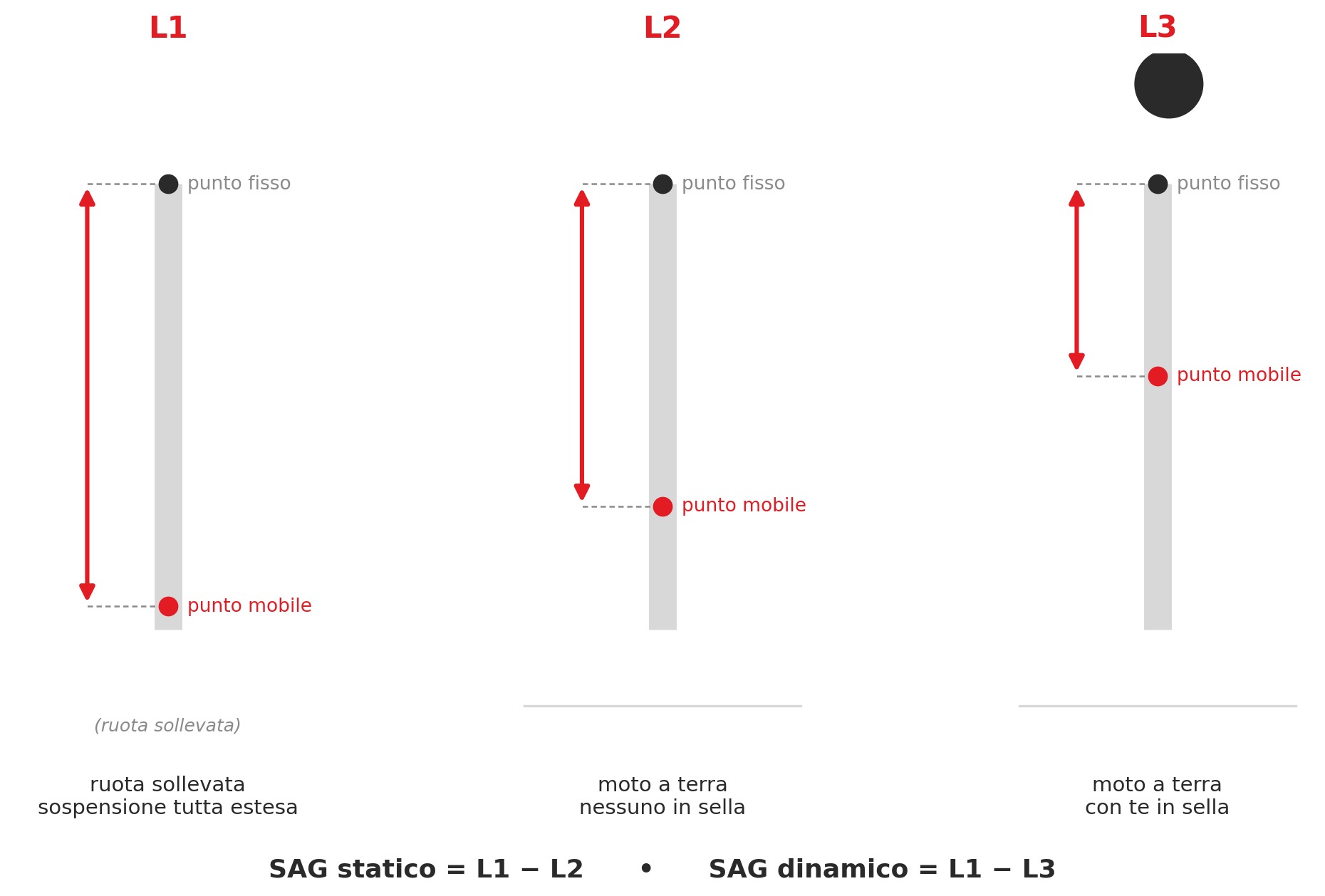
L1 with the wheel off the ground and the suspension fully extended. L2 with the bike on the ground, on its own. L3 with you sitting on it.
From these come the two numbers: static SAG is L1 minus L2, dynamic SAG is L1 minus L3. That's the whole of the maths.
Mark the points. Seriously, mark them.
You need one fixed point and one point that moves.
Rear: a point on the subframe, directly above the wheel axle, and the axle itself. Front: the bottom of the fork slider and a point on the stanchion.
Put down a strip of masking tape and mark it with a pen. Then don't touch either mark again until you're done.
This is the part I got wrong the first time. I measured without marking anything, keeping "roughly from here to there" in my head, and got three different numbers that all seemed plausible. The tricky part is you don't notice: the numbers come out, they look believable, you write them down. Except you're comparing measurements taken from different spots, so you're not really comparing anything.
Static SAG
Lift the bike until the wheel is free and the suspension is fully extended. Measure between the two marks. That's L1.
Put it back down, upright, with no one on it. Now push the suspension down a couple of times and let it rise back up on its own. This bounce isn't folklore: there's friction inside the suspension, and friction holds the bike wherever it happens to stop rather than where its true equilibrium is. Skip this and you're carrying five or six millimetres of fiction.
Measure again: L2.
Do it three times and average. You'll get three slightly different numbers, and that's normal — it's friction again. Take just one reading and you're picking at random within the range.
High static SAG means a spring too soft for that bike. Low static SAG means a spring too stiff. If you're way off, preload is a band-aid: the problem is the spring, not the adjustment.
Dynamic SAG
This is where it gets serious, and it's the measurement everything else gets built on.
Dress as you ride. Helmet, jacket, boots, and the backpack if you always carry one. The weight that matters is what you'll actually have on when riding, not what the scale says in the morning in your underwear. Between a bare rider and the same rider in full gear, eight to ten kilos can easily disappear.
And if you often ride two-up or loaded with luggage, measure that configuration too. It isn't the same bike with a bit extra: it's a different setup, and it needs its own SAG.
Get into riding position. Feet on the pegs, hands on the bars, weight distributed as it would be on the move. Not perched awkwardly with one foot on the ground.
Which is exactly why you need the friend: if you're holding the bike up with your own feet on the ground, part of your weight goes to the tarmac instead of the suspension. The number you get describes no real situation at all — not the bike parked, not the bike moving. It's just a number.
Bounce once and stop. A light push, let it settle. Then hold still.
Measure L3. Your third helper reads between the same two marks. Three times, average, same as before.
The five ways to waste an afternoon
These are always the same, and they're sneaky because none of them produces an obviously wrong result. They give you a wrong number that looks right.
- Changing reference points. If they're not the same, you're not measuring the same thing.
- Measuring on uneven ground. Side stand, sloped surface, bike leaning on a wall: the weight doesn't distribute the way it should.
- Holding the front brake. Locks the fork and stops it settling naturally. Happens often, out of pure habit, without noticing.
- Skipping the bounce. Internal friction hides half a centimetre from you.
- Taking one single reading. Three, then average. Every time, for both measurements.
Now you have two numbers
And on their own they still don't mean much, because forty millimetres on a supersport and forty on a big adventure bike tell two completely different stories.
The next step is figuring out which SAG your kind of riding actually needs. That's the next article, Which SAG Is Right for You.
If you already have the numbers and would rather skip the arithmetic, ClickGarage.AI takes them, cross-references them with your bike's travel, and tells you exactly where you stand against the target. Your first setup is free.
Run the numbers on your own bike
ClickGarage.AI works these values out from your bike's data and your real weight. Go to the calculator